Frequently Asked Questions
Basic Information
1. Why was a notice issued?
2. What is a class action?
3. What is this lawsuit about?
4. Why is there a Settlement?
Who’s Included In The Settlement
5. How do I know if I am in the Settlement Class?
The Settlement Benefits
6. What does the Settlement provide?
7. How much will my payment be?
8. When will I get my payment?
Deciding What To Do
9. How do I weigh my options?
10. What is the best path for me?
Submitting A Claim Form For A Settlement Payment
11. How do I get a payment?
Remaining In The Settlement
12. What am I giving up if I stay in the class?
13. What happens if I do nothing at all?
The Lawyers Representing You
14. Do I have a lawyer in the case?
15. How will the lawyers be paid?
Excluding Yourself From The Settlement
16. How do I opt out of the Settlement?
17. If I don’t exclude myself, can I sue the Defendant for the same thing later?
18. If I exclude myself, can I get a settlement payment?
Objecting To The Settlement
19. How do I object to the settlement?
20. What’s the difference between objecting and excluding myself from the settlement?
The Counrt’s Final Approval Hearing
21. When is the Court’s Final Approval Hearing?
22. Do I have to come to the hearing?
23. May I speak at the hearing?
24. Where do I get more information?
Basic Information
1. Why was a notice issued?
Judge Jon S. Tigar of the United States District Court for the Northern District of California authorized a notice in connection with a proposed class action settlement of a lawsuit he is overseeing. The lawsuit is known as In re Natera Prenatal Testing Litigation, Case No. 4:22-cv-00985 (N.D. Cal.). The people who sued, called the “Plaintiffs” or “Class Representatives,” are Amanda Davis, Lisa Cassinis, Lillian Delaurie, Laura Ashley Heryla, Sara Martinez, Yelena Kreynstein, Amanda Law, and Chelsey Stephens. The company that got sued, Natera, Inc., is called the “Defendant” or “Natera.” If you received a notice directly from the Settlement Administrator, Natera’s records indicate that you may be eligible to receive a payment from the Settlement.
Back To Top
2. What is a class action?
In a class action, one or more people called class representatives sue on behalf of a group or a “class” of people who have similar claims. In a class action, the court resolves the issues for all class members, except for those who choose to exclude themselves from the class.
Back To Top
3. What is this lawsuit about?
Plaintiffs claim that during their pregnancies, they purchased Natera’s noninvasive prenatal screening tests because Natera marketed its tests as being able to reliably and accurately test for whether babies have certain genetic disorders. Plaintiffs allege that Natera’s noninvasive prenatal screening tests do not, however, reliably test for some rare genetic disorders and that Natera omitted material information about the tests’ reliability and accuracy from its marketing materials and website, in violation of implied warranty and consumer protection laws.
Natera maintains that its noninvasive prenatal screening tests were and are highly reliable and accurate, and Natera denies that it failed to disclose material information regarding these tests. Natera maintains that its noninvasive prenatal screening tests, and their reliability and accuracy, have been established through multiple clinical studies, and results from those studies and other research regarding the tests are available in nearly 50 peer-reviewed publications. Natera denies any wrongdoing and denies that it violated any law.
Back To Top
4. Why is there a Settlement?
The Court has not decided whether the Plaintiffs or the Defendant should win this case. Instead, both sides agreed to a Settlement. That way, they avoid the uncertainties, burdens, and expenses associated with ongoing litigation, and Settlement Class Members will get compensation now rather than years from now, if at all. More information about the Settlement and the lawsuit is available here, or by accessing the Court docket in this case, for a fee, through the Court’s Public Access to Court Electronic Records (PACER) system at https://ecf.cand.uscourts.gov, or by visiting the office of the Clerk of the Court for the United States District Court for the Northern District of California, Oakland Courthouse, between 9:00 a.m. and 4:00 p.m., Monday through Friday, excluding Court holidays.
Back To Top
Who’s Included In The Settlement
5. How do I know if I am in the Settlement Class?
The Court decided that everyone who fits this description and chooses not to request to be excluded is a member of the Settlement Class:
All individuals in the United States who paid out of pocket for a Natera noninvasive prenatal screening test (Panorama or Vasistera) from the dates listed below.
State(s) | Dates |
Ohio | February 17, 2016 - August 7, 2025 |
New Jersey | May 5, 2016 - August 7, 2025 |
Florida | February 24, 2017 - August 7, 2025 |
New York & Illinois | April 27, 2017 - August 7, 2025 |
All other states | February 17, 2018 - August 7, 2025 |
You paid “out of pocket” if you paid any portion of the price for a Natera noninvasive prenatal screening test under the brand names Panorama or Vasistera, including any copay, co-insurance, or deductible.
Persons whose Natera noninvasive prenatal screening tests were paid for entirely by insurance or some other third-party source are excluded from the Settlement Class. Also excluded from the Settlement Class are (1) any Judge or Magistrate presiding over this action and members of their families, (2) Defendant, Defendant’s subsidiaries, parent companies, successors, predecessors, and any entity in which Defendant or its parents have a controlling interest, and their current or former officers, directors, and employees, (3) counsel of record (and their respective law firms) for the Parties; (4) persons who properly execute and file a timely request for exclusion from the class, and (5) the legal representatives, successors or assigns of any such excluded persons.
Back To Top
The Settlement Benefits
6. What does the Settlement provide?
If the Settlement is approved by the Court, Defendant will create a settlement fund totaling $8,250,000.00. Class member payments, as well as the cost to administer the Settlement, the cost to inform people about the Settlement, attorneys’ fees and costs, and a service award to the Class Representatives will come out of this fund if approved by the Court. However, you give up your right to sue Natera for the claims released by this Settlement.
Back To Top
7. How much will my payment be?
If you are member of the Settlement Class, you will receive either (i) up to $30.00 if you submit a claim without proof of purchase, or (ii) 10% of your documented proof of purchase of Natera’s noninvasive prenatal screening tests, if your out-of-pocket costs were greater than $300.00 Your payments may be increased or decreased proportionally compared to other Settlement Class Members who file a claim, except that claims submitted without proof of purchase will not exceed $30.00, and claims submitted with proof of purchase will not exceed the claimant’s out-of-pocket costs.
More information about how payments will be calculated is available in the Plan of Allocation (§ __ of the Settlement Agreement).
Back To Top
8. When will I get my payment?
If your claim is approved, you should receive a check or electronic payment from the Settlement Administrator after the Settlement has been finally approved and/or after any appeals process is complete. The hearing to consider the final fairness of the Settlement is scheduled for April 23, 2026. All checks will expire and become void 180 days after they are issued. If appropriate, funds remaining from uncashed checks may be redistributed, or donated to one or more charities agreed on by the Parties and approved by the Court.
Back To Top
Deciding What To Do
9. How do I weigh my options?
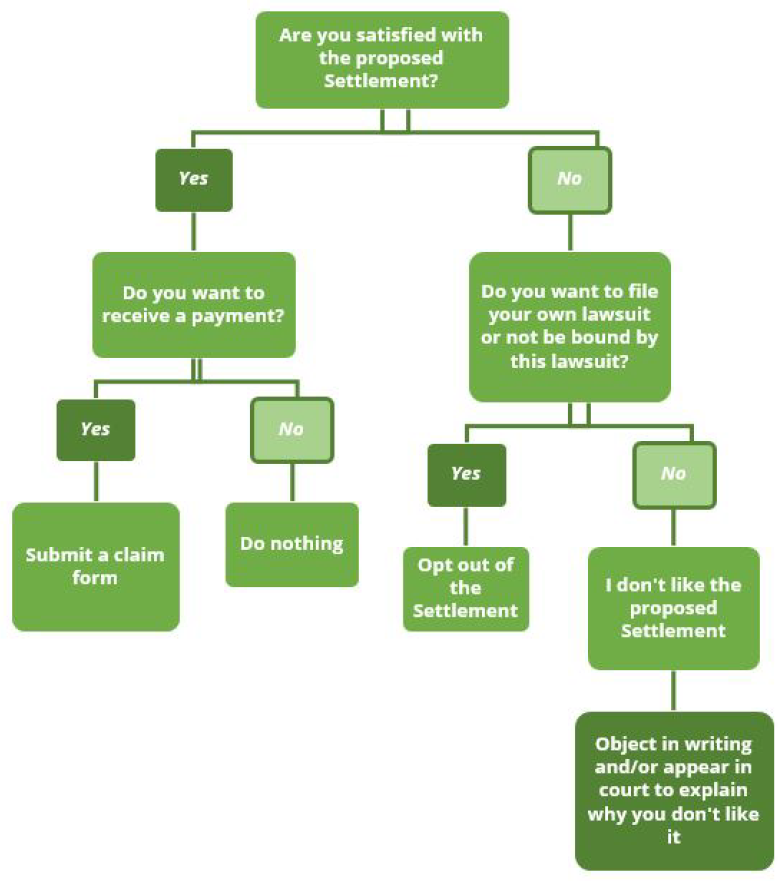
You have four options. You can stay in the Settlement and submit a claim, you can opt out of the Settlement, you can object to the Settlement, or you can do nothing. This chart shows the effects of each option:
Submit a Claim | Opt Out | Object | Do Nothing | |
Can I receive Settlement money if I . . . | Yes | No | Yes | No |
Am I bound by the terms of this Settlement if I . . . | Yes | No | Yes | Yes |
Can I pursue my own case if I . . . | No | Yes | No | No |
Will the class lawyers represent me if I . . . | Yes | No | No | Yes |
Back To Top
10. What is the best path for me?
Back To Top
Submitting A Claim Form For A Settlement Payment
11. How do I get a payment?
If you received notice directly from the Settlement Administrator, you are eligible to participate in the Settlement. You must submit a Claim Form by March 23, 2026 to be eligible for benefits.
If you did not receive notice directly from the Settlement Administrator, but believe you are part of the Settlement Class, you can still submit a Claim Form by March 23, 2026 to determine your eligibility for benefits.
Claim Forms can be found and submitted online and can also be submitted by mail.
We encourage you to submit your claim electronically here. Your Unique ID and PIN can be found on The Notice you might have received. Not only is it easier and more secure, but it is completely free and takes only minutes!
Back To Top
Remaining In The Settlement
12. What am I giving up if I stay in the class?
If the Settlement becomes final, you will give up your right to sue the Defendant for the claims being resolved by this Settlement. The specific claims you are giving up against the Defendant are described in the Settlement Agreement. You will be “releasing” the Defendant and certain related parties (collectively, the “Released Parties”), described in Sections 1.29 and 2.6 of the Settlement Agreement. Unless you exclude yourself, you are “releasing” the claims. The Settlement Agreement is available here.
The Settlement Agreement describes the released claims with specific descriptions, so read it carefully. If you have any questions you can talk to the lawyers listed in FAQ 14 for free by calling (415) 981-4800 or (925) 300-4455, or you can, of course, talk to your own lawyer if you have questions about what this means.
Back To Top
13. What happens if I do nothing at all?
If you do nothing, you won’t get any payments from this Settlement. But, unless you exclude yourself, you won’t be able to bring or participate in any other lawsuit against the Defendant for the claims seeking economic damages that are being resolved by this Settlement.
Back To Top
The Lawyers Representing You
14. Do I have a lawyer in the case?
The Court has appointed lawyers at the firms Girard Sharp and Bursor & Fisher to represent the Settlement Class. They are called “Class Counsel.” These lawyers do not represent you individually, only as a member of the Settlement Class. They are experienced in handling similar class action cases.
Dena C. Sharp
Girard Sharp LLP
601 California Street, 14th Fl.
San Francisco, CA 94108
Telephone: (415) 981-4800
L. Timothy Fisher
Bursor & Fisher, P.A.
1990 North California Boulevard, 9th Floor
Walnut Creek, CA 94596
Telephone: (925) 300-4455
More information about these lawyers, their law firm, and their experience is available at www.girardsharp.com and www.bursor.com. They believe, after conducting an extensive investigation, that the Settlement Agreement is fair, reasonable, and in the best interests of the Settlement Class. You will not be charged for these lawyers. You are not required to hire a lawyer, but if you want to be represented by your own lawyer in this case, you may hire one at your expense.
The Court also appointed Amanda Davis, Lisa Cassinis, Lillian Delaurie, Laura Ashley Heryla, Sara Martinez, Yelena Kreynstein, Amanda Law, and Chelsey Stephens as Class Representatives.
Back To Top
15. How will the lawyers be paid?
Class Counsel’s attorneys’ fees and costs will be paid from the Settlement Fund in an amount to be determined and awarded by the Court. You will not have to pay Class Counsel directly. The fee petition will seek no more than 30% of the Settlement Fund plus any interest accrued, as well as reimbursement of reasonable costs they sustained in litigating the case up to $300,000.00. The Court may award less than this amount. Under the Settlement, any amount awarded to Class Counsel will be paid out of the Settlement Fund. Lawyers’ fees and expenses will only be awarded if approved by the Court as a fair and reasonable amount. You have the right to object to the lawyers’ fees and expenses even if you think the Settlement is fair, using the procedures described below. Class counsel’s motion for the payment of attorneys’ fees and expenses will be available in the Important Documents by February 18, 2026. Subject to approval by the Court, each Class Representative will be paid up to $10,000.00 from the Settlement Fund.
Back To Top
Excluding Yourself From The Settlement
16. How do I opt out of the Settlement?
You have the right to opt out of the Settlement Class—also known as “excluding yourself” from the Class. If you exclude yourself from the Settlement Class, you will not be eligible to receive payment from the Settlement, but you may be able to file a lawsuit against (or continue to sue) Natera, about the legal claims brought on behalf of the Settlement Class. If you opt out of the Class so that you can start your own lawsuit against Natera, you should talk to your own lawyer soon, because you may have missed the deadline to file a lawsuit. You will be responsible for the cost of any services provided by your own lawyer.
You can exclude yourself from the Settlement by mailing a request for exclusion to the Settlement Administrator. To be effective, the request for exclusion must:
Include your full name, telephone number, mailing address, and email address;
Contain a clear statement that you wish to exclude yourself from the Settlement Class;
Clearly identify the case name and number: “In re Natera Prenatal Testing Litigation, Case No. 4:22-cv-00985 (N.D. Cal.);”
Include your signature or a signature of an individual authorized to act on your behalf; and
Be postmarked or emailed by March 23, 2026, to:
In re Natera Noninvasive Prenatal Testing Litigation Settlement
Attn: Exclusion Requests
PO Box 25224
Santa Ana, CA 92799
Email: info@NateraNIPTSettlement.com
This will be your only opportunity to opt out of the Settlement Class. Each person who submits an opt-out request must do so individually. Opt-outs submitted on behalf of two or more persons belonging to the Settlement Class are prohibited.
Back To Top
17. If I don’t exclude myself, can I sue the Defendant for the same thing later?
No. Unless you exclude yourself, you give up any right to sue the Defendant for the claims being resolved by this Settlement.
Back To Top
18. If I exclude myself, can I get a settlement payment?
No. If you exclude yourself, you should not submit a Claim Form to ask for a payment because you won’t receive one.
Back To Top
Objecting To The Settlement
19. How do I object to the settlement?
You can ask the Court to deny approval by filing an objection. You can’t ask the Court to order a different settlement; the Court can only approve or reject the settlement being proposed. If the Court denies approval, no settlement payments will be sent out and the lawsuit will continue. If that is what you want to happen, you must object. If you disagree with any part of the Settlement Agreement (including the lawyers’ fees and expenses), but don’t want to opt out, you may object.
Any objection to the proposed Settlement must be in writing. If you file a timely written objection, you may, but are not required to, appear at the final approval hearing, either in person or through your own attorney. If you appear through your own attorney, you are responsible for hiring and paying that attorney. If you want to appear and speak at the Final Approval Hearing to object to the Settlement, with or without a lawyer (see FAQ 23), you must say so in your letter or brief.
All written objections and supporting papers must:
clearly identify the case name and number: “In re Natera Prenatal Testing Litigation, Case No. 4:22-cv-00985 (N.D. Cal.);”
be submitted to the Court by March 23, 2026, either by mailing them to the Class Action Clerk, United States District Court for the Northern District of California, Ronald V. Dellums Federal Building & United States Courthouse, 1301 Clay Street, Oakland, California 94612, or by filing them in person at any location of the United States District Court for the Northern District of California;
include your full name, mailing address, telephone number, and email address;
describe the specific reasons for your objection;
include the name, address, bar number, and telephone number of any and all attorneys representing you in connection with your objection;
list any objections to class actions you or your attorney has made within the last five years;
state whether you or your attorney will appear at the final approval hearing in person;
include your signature and the signature of any attorney representing you; and
Be postmarked or emailed by March 23, 2026, to:
In re Natera Noninvasive Prenatal Testing Litigation Settlement
Attn: Objection
PO Box 25224
Santa Ana, CA 92799
Email: info@NateraNIPTSettlement.com
Back To Top
20. What’s the difference between objecting and excluding myself from the settlement?
Objecting simply means telling the Court that you don’t like something about the Settlement. You can object only if you stay in the Settlement Class. Excluding yourself from the Class is telling the Court that you don’t want to be part of the Settlement Class. If you exclude yourself, you have no basis to object because the case no longer affects you.
Back To Top
The Counrt’s Final Approval Hearing
21. When is the Court’s Final Approval Hearing?
The Court will hold the final approval hearing on April 23, 2026, in courtroom 6 at the Ronald V. Dellums Federal Building & United States Courthouse, 1301 Clay Street, Oakland, California 94612. The purpose of the hearing will be for the Court to determine whether to approve the Settlement as fair, reasonable, adequate, and in the best interests of the Settlement Class; to consider Class Counsel’s request for attorneys’ fees and expenses; and to consider the request for a service award to the Class Representatives. At that hearing, the Court will be available to hear any objections and arguments concerning the fairness of the Settlement.
The hearing may be postponed to a different date or time without notice, so it is a good idea to check this website regularly. If, however, you timely objected to the Settlement and advised the Court that you intend to appear and speak at the final approval hearing, you should receive notice from the Court of any change in the date of such final approval hearing.
Back To Top
22. Do I have to come to the hearing?
No. Class Counsel will answer any questions the Court may have. But you are welcome to come at your own expense. If you send an objection or comment, you don’t have to come to Court to talk about it. As long as you filed and mailed your written objection on time, the Court will consider it. You may also pay another lawyer to attend, but it’s not required.
Back To Top
23. May I speak at the hearing?
Yes. You may ask the Court for permission to speak at the Final Approval Hearing. To do so, you must include in your letter or brief objecting to the settlement a statement saying that it is your “Notice of Intent to Appear in In re Natera Prenatal Testing Litigation, Case No. 4:22-cv-00985 (N.D. Cal.).” It must include your name, address, telephone number and signature as well as the name and address of your lawyer, if one is appearing for you. Your objection and notice of intent to appear must be filed with the Court and postmarked no later than March 23, 2026.
Back To Top
24. Where do I get more information?
This website and the Notice are a summary of the Settlement. More details are in the here. You can get a copy of the Settlement Agreement here. You can also get information about this case by accessing the Court docket, for a fee, through the Court’s Public Access to Court Electronic (PACER) system at https://ecf.cand.uscourts.gov, or by visiting the office of the Clerk of the Court for the United States District Court for the Northern District of California, Oakland Courthouse, between 9:00 a.m. and 4:00 p.m., Monday through Friday, excluding Court holidays.
You may also contact the Settlement Administrator by mail, email, or by calling toll-free:
In re Natera Prenatal Testing Settlement
PO Box 25224
Santa Ana, CA 92799
Email: info@NateraNIPTSettlement.com
Toll-Free: (844) 496-0872
You may also call Class Counsel at (415) 981-4800 or (925) 300-4455, if you have any questions. Before doing so, however, please read the full Notice carefully
Please Do Not Telephone The Court Or The Court Clerk’s Office To Inquire About This Settlement Or The Claim Process. All questions regarding the Settlement or claims process should be directed to the Settlement Administrator or to Class Counsel
Back To Top